
Builder, Philanthropist, Patriot: The Story of Zachary and Elizabeth Fisher
A Bricklayer’s Son
Zachary Fisher was born in Brooklyn on September 26, 1910, a son of a Russian immigrant bricklayer who taught his boys the masonry trade. At sixteen, Zachary left school and went to work in construction to help support his parents. With his brothers Martin and Larry he built Fisher Brothers into one of New York’s premier residential and commercial developers, a firm responsible for more than five million square feet of Manhattan office space and buildings like the Imperial House on Lexington Avenue. When he died, the obituaries credited the brothers with helping reshape the city’s skyline.
The Injury
The trade that made him also marked him. As a young man, Fisher was badly hurt in an accident on a construction site, leaving him with a serious leg injury. With the country at war, he tried to enlist in the Marine Corps and was rejected on medical grounds. The congressional resolution that honored him decades later recorded the moment in dry statutory language: he “attempted to enlist in the Armed Forces to serve his country during World War II,” and was informed he was ineligible due to a preexisting medical condition.
He spent the war years building anyway, assisting in the construction of coastal fortifications. For most men, that would have settled the account. Fisher spent the next five decades acting as if it hadn’t.
He asked to serve and was told no. He spent the next fifty years answering anyway.
The Intrepid and the Checks
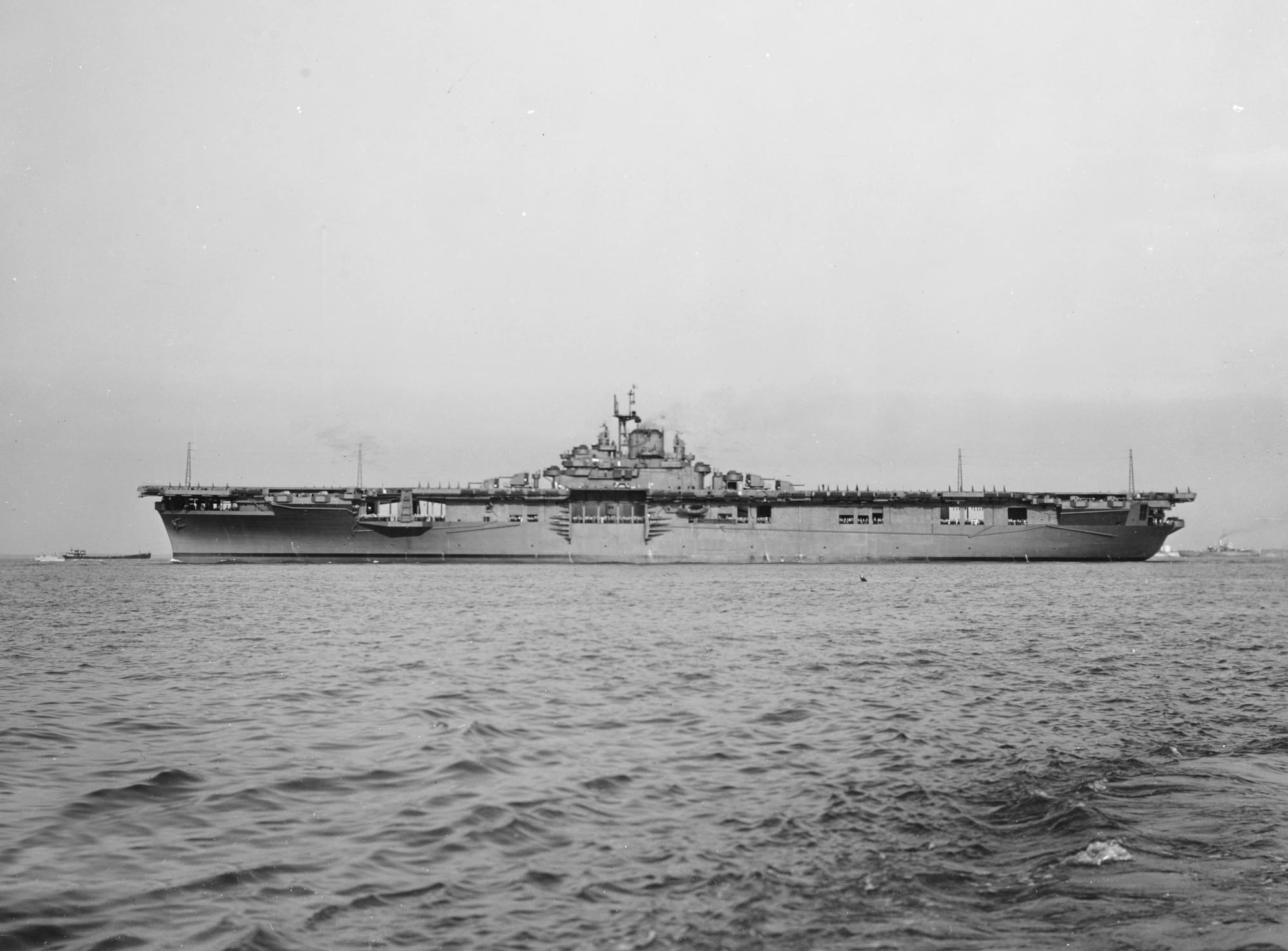
By the late 1970s, the aircraft carrier USS Intrepid, which had survived repeated kamikaze attacks during World War II and served through Vietnam, was headed for the scrapyard. Charleston knows her lines well: Intrepid is an Essex-class carrier, a sister ship of the USS Yorktown moored across our own harbor at Patriots Point. Fisher founded the Intrepid Museum Foundation in 1978 to save her, invested millions of dollars of his own in the effort, and in 1982 the ship opened at Pier 86 on the Hudson as the Intrepid Sea, Air & Space Museum.
 ThenNowTap to reveal
The same year the museum opened, Zachary and his wife established the Zachary and Elizabeth M. Fisher Armed Services Foundation. Its work soon became terribly concrete. On October 23, 1983, a truck bomb destroyed the Marine barracks in Beirut and killed 241 American service members. The Fishers sent a check for $10,000 to each of the 241 families.
They never stopped. For more than two decades the Fishers sent checks, eventually as much as $25,000, to the families of service members killed in the line of duty, among them the families of the sailors lost in the USS Iowa turret explosion in 1989, and to the families of New York City firefighters as well. In later years the checks arrived with a personal letter acknowledging that no amount of money could compensate the loss; the Fishers simply wanted each family to know that two strangers cared. The practice outlived Zachary himself: soon after his death it inspired the creation of the Intrepid Fallen Heroes Fund.
“I’m a Builder”
The idea that became Fisher House belonged to a Navy wife. In the 1970s, Pauline Trost watched a sailor’s family arrive by helicopter at the National Naval Medical Center in Bethesda, luggage in hand, and wondered where they would stay while their loved one lay in a hospital bed. The question stayed with her for years.
In 1990, Zachary Fisher called her husband, Admiral Carlisle Trost, offering to expand his support for service families. Trost mentioned his wife’s idea. In Pauline Trost’s own account, Fisher’s answer came without hesitation.
“I’m a builder, I have my own architect, we can do this.”
The first Fisher House opened at Bethesda on June 24, 1991, with President George H. W. Bush and First Lady Barbara Bush at the dedication. Fisher was eighty years old. He and Elizabeth would ultimately dedicate more than $20 million of their own money to building comfort homes where families could stay, free of charge, steps from the hospitals treating the people they loved.
Elizabeth was a full partner in all of it, and her service had started earlier than his. Born in Allegheny County, Pennsylvania, in 1913, she was a Ziegfeld performer who spent World War II with the USO, entertaining more than 157,000 troops overseas alongside Bob Hope, and she volunteered at the bedsides of hospitalized service members for years afterward. She and Zachary married during the 1940s and became partners in everything that followed.
There is a bittersweet turn in the story, and it lands in the same year the phone call did. In 1990, Elizabeth was diagnosed with Alzheimer’s disease. While the first houses were going up, the Fishers were living through a medical crisis of their own. Four years after the diagnosis, their medical foundation joined David Rockefeller in providing $5 million to establish the Zachary and Elizabeth M. Fisher Center for Research on Alzheimer’s Disease at Rockefeller University, which today supports one of the country’s largest laboratories devoted to the disease.
The Honorary Veteran
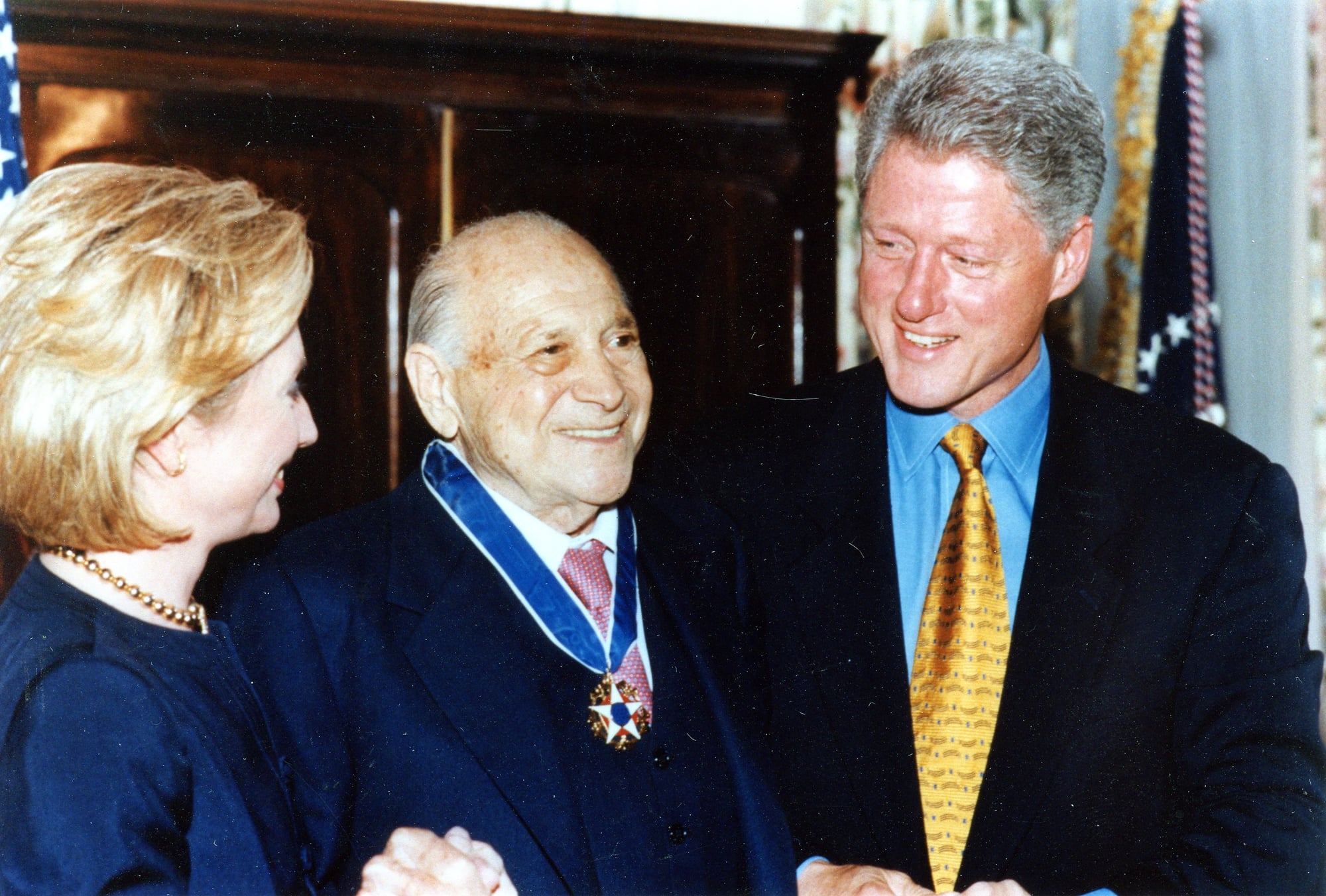
On September 14, 1998, President Clinton awarded Zachary Fisher the Presidential Medal of Freedom, the nation’s highest civilian honor. The citation read: “Zachary Fisher’s generosity towards our military families is unsurpassed in our Nation’s history.” The photograph at the top of this page was taken that day. He had already received the Presidential Citizens Medal, the Horatio Alger Award, and the top civilian honors of each service branch, and in 1997 the Navy had christened a ship, USNS Fisher, in honor of him and Elizabeth together.
Fisher died on June 4, 1999, at 88. “The brave men and women of the United States military have lost a true friend,” President Clinton said that day, “and America has lost a true patriot.”
Six months later, on December 9, 1999, the President signed Public Law 106-161, a joint resolution conferring upon Zachary Fisher the status of honorary veteran of the United States Armed Forces. Bob Hope remains the only other individual so honored. Fisher’s tomb needs three words to explain him: Builder. Philanthropist. Patriot. Elizabeth outlived her husband by five years and died on January 12, 2004, at 90.
From Bethesda to Wentworth Street
The house Pauline Trost imagined and Zachary Fisher built became a network. In 2025, the Fisher House program opened its 100th house, in North Chicago, and the network now includes 100 houses at more than 70 military and VA medical-center locations, including sites in Germany and the United Kingdom. By the Fisher House Foundation’s estimate, the program has saved military and veteran families approximately $690 million in lodging and transportation costs. The Foundation remains a family undertaking: Kenneth Fisher, Zachary’s great-nephew, serves as its chairman and CEO, and he was in Charleston in November 2016 to help break ground at 150 Wentworth Street. Zachary had made the promise himself years earlier.
“Where there is a military, there will always be a Fisher House. Where there is a Fisher House, there will always be love and caring, warmth and compassion.”
The Charleston Fisher House welcomed its first families in January 2018. As of September 2026, it had served 9,572 veteran families and saved them an estimated $5.97 million in lodging costs, at no cost to any guest family. Exactly who does what inside the house is a story of its own.
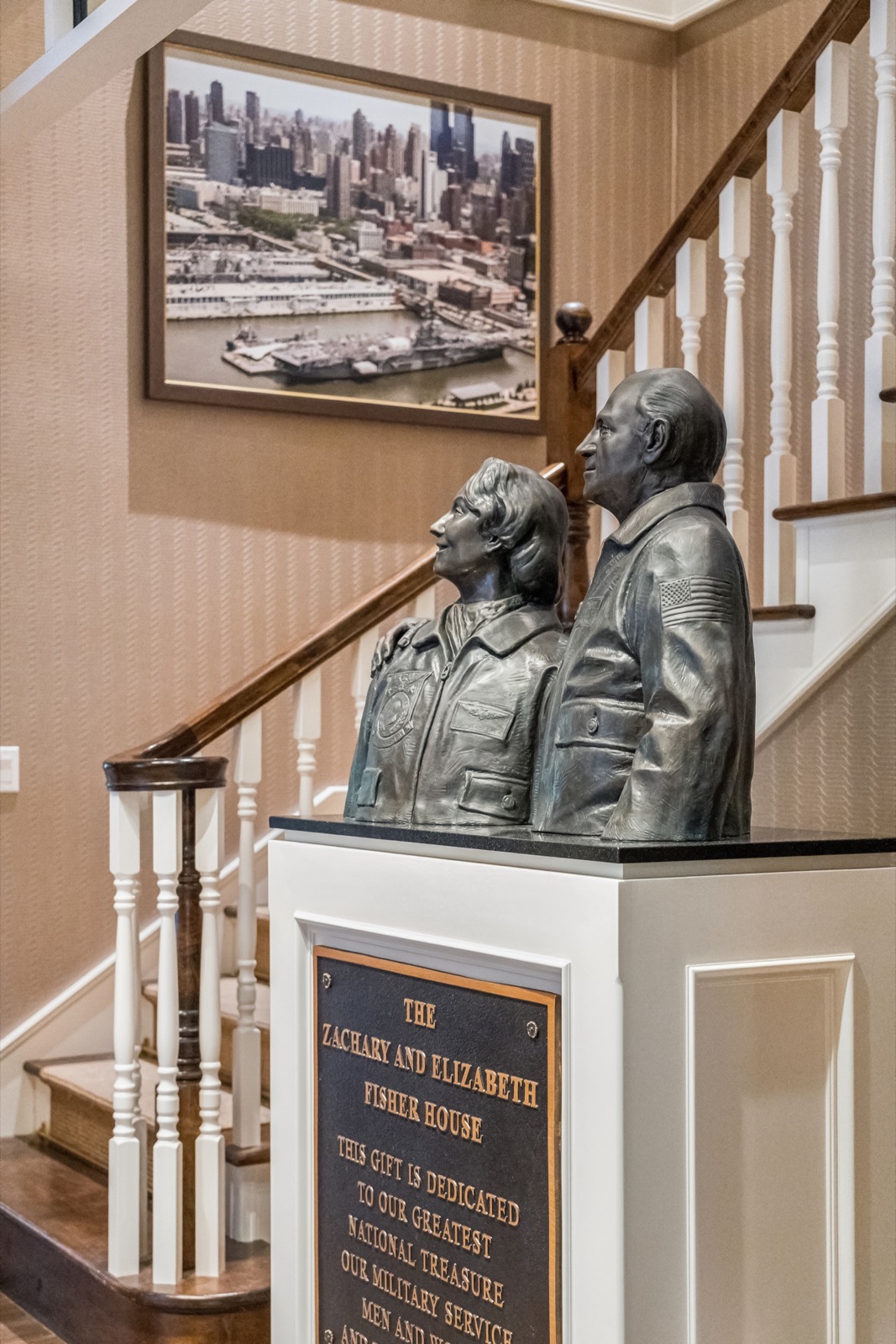
Which brings the story back to the staircase. The bronzes show the two of them together, Zachary’s arm around Elizabeth’s shoulder, an American flag stitched on his sleeve. On the wall above them hangs a photograph of the Intrepid at its Manhattan pier, the ship whose rescue became one of his defining acts. The plaque below carries the same dedication that hangs in every house he built: a gift to our greatest national treasure, our military service men and women and their loved ones.
Most guests pass the busts with a suitcase in one hand, in the middle of one of the hardest weeks of their lives. No one asks them to stop and take in the history. But the two people in bronze would have recognized every one of them on sight: a family in crisis, far from home, needing a place to stay. More than eighty years after a recruiter told Zachary Fisher no, the answer he gave instead is still arriving, one family at a time.